Study and research for the Ph.D .in Agricultural and Applied Economics typically requires four years beyond the MS degree.
- The first year is devoted to completing the Ph.D. core courses which cover the theory and quantitative methods upon which field or elective courses in agricultural and consumer economics are based.
- The second year is usually devoted to courses in the student's chosen area(s) of specialization and to completion of an independent research paper.
- The third year students present their research paper, complete research, and orally defend a proposal for dissertation topic.
- The fourth year student defend their final exam and deposit their dissertation.
Upon completing courses and passing a written preliminary examination, doctoral students must complete a significant research paper and orally defend a proposal for dissertation research. The oral defense assesses their preparation and plans for independent research and other related topics. Each Ph.D. candidate presents the completed research in a final dissertation defense.
The Ph.D. degree is a STEM-designated program.
To view the general requirements of the PhD program, see the university's academic catalog. We have also created a sample program below to help visualize how a Ph.D. student's time would be spent.
Sample Program
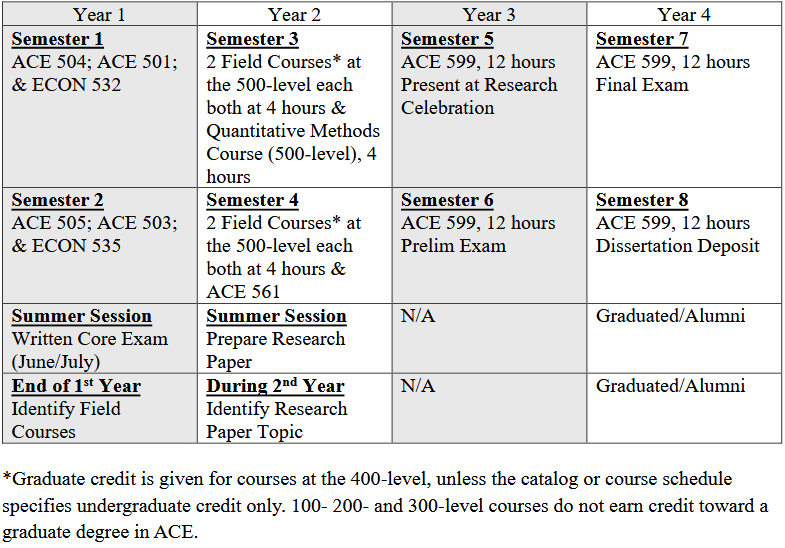
ACE PhD Program
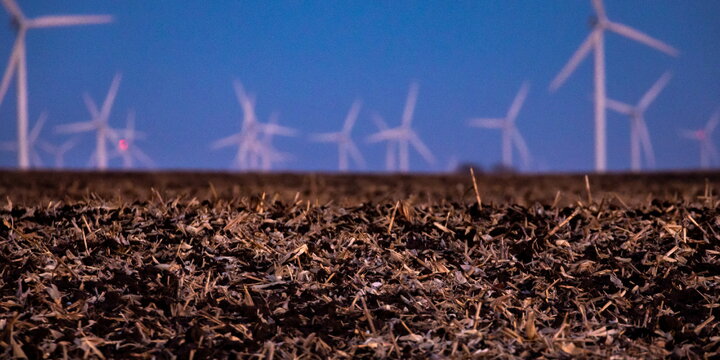
Food, Agriculture, and Commodities
We evaluate food and agricultural systems, such as market price behavior, food demand, risk management, conservation and sustainability, farm management, financial markets, innovation and technology adoption, and policy impacts.
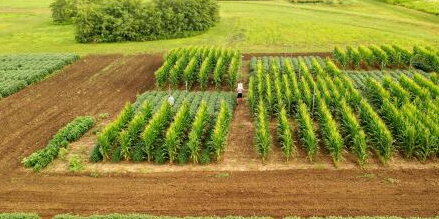
Environmental and Resource Economics
We yield knowledge about issues such as managing natural resources, designing conservation strategies, assessing the impact of climate change, and developing policies that improve society and the environment.

Household and Health Economics
We investigate individual and household behavior in areas such as food, education, health, savings, financial planning, and retirement.

International, Regional and Development Economics
We study the role of government in economic development, poverty, marketing, international trade, and agriculture.

Policy and Law
We address critical issues related to agricultural, environmental, and food policy and law that have a significant impact in the United States, the European Union, and other regions of the world.
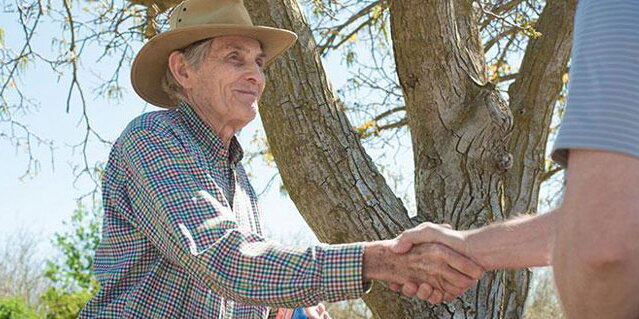
Extension and Outreach
We provide programs and resources to support people, businesses, and our community.